
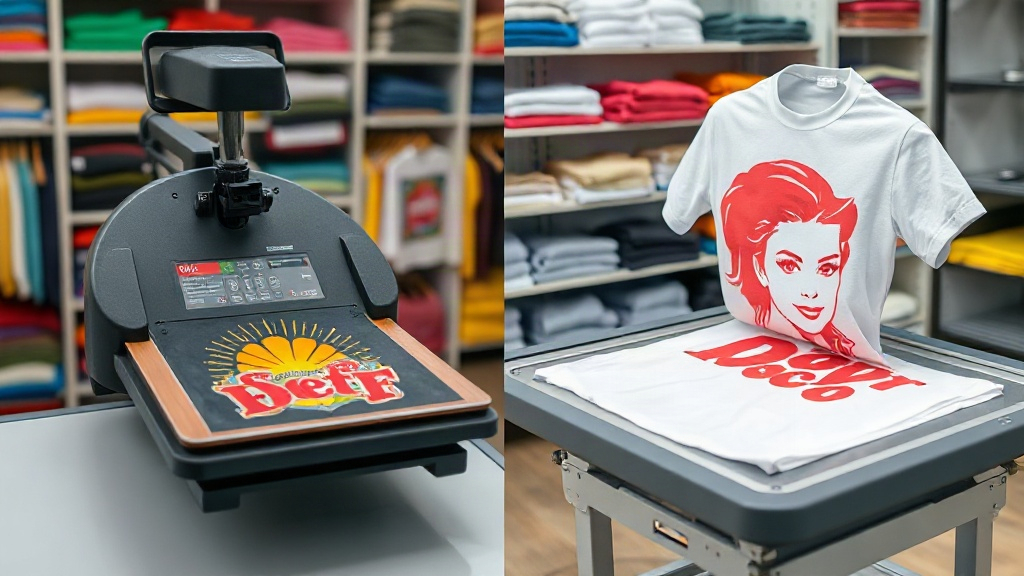
If you run a custom apparel business, you have likely faced the dilemma of choosing between DTF transfers and screen printing for your orders. Both methods have loyal fans, and each shines in different scenarios. After using both techniques for years, I have seen how the right choice can save you time, money, and a lot of frustration. In this article, I will break down the key differences so you can make an informed decision for your shop.
What Are DTF Transfers?
DTF transfers (Direct-to-Film) are a relatively new printing technology that has taken the garment decoration world by storm. The process involves printing your design onto a special PET film using water-based inks, then applying a hot-melt powder to the wet ink. After curing, the transfer is ready to be heat-pressed onto fabric. Unlike DTG or screen printing, DTF does not require pre-treatment or special coatings on the garment. This makes it incredibly versatile for different fabric types, including cotton, polyester, blends, and even nylon.
One of the biggest advantages of DTF transfers is the ability to produce full-color, photographic-quality images without the setup costs associated with screen printing. You can print one-off designs or small batches economically, which is perfect for custom orders, samples, or personalization.
What Is Screen Printing?
Screen printing, also known as silkscreen printing, has been the industry standard for decades. It involves creating a stencil (screen) for each color in your design, then pushing ink through the mesh onto the fabric. Each color requires a separate screen, and the setup can be time-consuming and costly. However, once the screens are made, screen printing offers unmatched speed for large runs and a distinctive, durable finish that many customers love.
Screen printing excels with bold, solid colors and high-volume orders. It is the go-to method for sports teams, bands, and promotional products where hundreds or thousands of identical items are needed.
Key Differences Between DTF Transfers and Screen Printing
1. Setup Cost and Minimum Order Quantity
Screen printing comes with significant upfront costs. You need to create a screen for each color, which can range from $20 to $50 per screen depending on your supplier. For a five-color design, that is $100 to $250 just in setup fees. This cost makes small orders prohibitively expensive. In contrast, DTF transfers have no setup fees. You can print a single transfer for just a few dollars, making them ideal for one-offs, samples, or small businesses testing new designs.
2. Print Quality and Detail
Screen printing produces vibrant, opaque colors that stand out on any garment. It works best with simple, bold graphics. However, it struggles with fine details, gradients, and photorealistic images. DTF transfers, on the other hand, can reproduce intricate details, smooth gradients, and even photographs with impressive accuracy. The result is a soft, flexible print that feels like part of the fabric.
That said, screen printing can achieve a thicker ink layer that some customers prefer for a retro or textured look. DTF prints are generally thinner and more stretchable, which is great for athletic wear.
3. Durability and Washability
Both methods are durable when done correctly. Screen-printed garments can withstand dozens of washes without fading, especially if the ink is properly cured. DTF transfers have also improved significantly in recent years; with proper heat press settings and quality materials, they can last just as long. However, improper application can lead to cracking or peeling. I always recommend following the transfer supplier's instructions to the letter.
4. Production Speed and Workflow
For large orders, screen printing is faster once the screens are set up. You can print hundreds of shirts in an hour with a carousel press. DTF transfers require printing the film, applying powder, curing, and then heat-pressing each item. This makes them slower for big batches but much faster for small runs since there is no setup time. If you offer same-day service or personalized items, DTF is a game-changer.
5. Fabric Compatibility
Screen printing works best on cotton and cotton blends. It can be used on polyester, but you need special inks and careful curing to avoid dye migration. DTF transfers adhere well to a wide range of fabrics, including polyester, nylon, leather, and even metal. This versatility means you can offer more products without investing in multiple printing setups.
When to Choose DTF Transfers
- You need small quantities or one-off custom items.
- Your designs have many colors, gradients, or fine details.
- You work with diverse fabrics beyond cotton.
- You want to offer quick turnaround without setup costs.
- You are just starting out and have a limited budget.
When to Choose Screen Printing
- You have large orders of 50+ pieces with the same design.
- Your design uses one to three solid colors.
- You want the classic, thick ink feel that some customers prefer.
- You have a high-volume production setup and can handle screen creation.
Can You Use Both?
Absolutely. Many successful shops offer both services. They use DTF transfers for samples, small orders, and complex designs, while relying on screen printing for big bulk orders. This hybrid approach gives you maximum flexibility and can help you attract a wider range of clients. For example, a local sports team might need 100 shirts with a simple logo (screen printing), while a boutique might order 10 shirts with a detailed photo (DTF).
Cost Breakdown: A Real-World Example
Let's say you have a design with four colors and you need 20 shirts. With screen printing, you would pay for four screens (approximately $100) plus the cost per shirt (around $3 each), totaling $160. With DTF transfers, you would pay about $2 per transfer (no setup), so $40 total. That is a savings of $120. Now, if you need 200 shirts, screen printing becomes cheaper: $100 setup + $600 printing = $700, while DTF would be $400. So DTF is still cheaper? Wait, actually for 200 shirts, screen printing might be $100 + $600 = $700, while DTF at $2 each is $400. That seems off; let's recalculate: Actually, screen printing costs decrease with volume. Typically, after setup, the per-shirt cost drops to $1 or less for large runs. So for 200 shirts, screen printing might be $100 + $200 = $300, while DTF at $2 each is $400. So screen printing wins for large orders. Always do the math based on your specific quotes.
Expert Tips for Getting Started
If you are new to DTF transfers, invest in a good heat press with even pressure and accurate temperature control. A quality press makes all the difference in adhesion and durability. Also, experiment with different powders and films to find what works best for your fabrics. For screen printing, learn proper emulsion coating and exposure techniques; it will save you countless headaches.
Another tip: Keep a sample library. Print a test shirt with each new transfer type or ink batch and wash it multiple times to verify durability. This practice has saved me from many customer complaints.
Frequently Asked Questions
How long do DTF transfers last on shirts?
With proper application and care, DTF transfers can last 50+ washes. Always wash inside out in cold water and avoid high heat in the dryer.
Can I use DTF transfers on dark colors?
Yes, DTF transfers include a white ink base that makes colors pop on dark fabrics. You do not need a separate white underbase like with DTG.
Is screen printing better for large orders?
For orders over 50 pieces with simple designs, screen printing is usually more cost-effective and faster. However, for complex designs, DTF may still be competitive.
What equipment do I need for DTF transfers?
You need a DTF printer, hot-melt powder, a curing oven or heat press, and a heat press for application. Start with a reliable printer and quality supplies.
Can I mix DTF and screen printing in one order?
Absolutely. Many shops use DTF for names and numbers on the back of shirts and screen printing for the front logo. Just ensure compatibility with your fabrics and inks.
Choosing between DTF transfers and screen printing ultimately depends on your specific needs. Consider your order volume, design complexity, fabric types, and budget. With the insights above, you can make a confident decision that boosts your business and keeps your customers happy.